
Shorter autumn days and headlight glare expose vision changes that a DMV test never checks. A comprehensive exam finds the reason, and sometimes a broader health condition.
You leave the office at 6:40 in mid-October and it is already dark. On the westbound drive home on Route 50, the oncoming headlights do not just look bright. They smear, flare, and leave a haze you have to blink through before you can find the lane again.
That is a common October report in our Aldie exam room, and it is a good reason to look at the calendar. A comprehensive eye exam is the only way to know whether the glare is a small prescription change, dry eyes scattering light across your cornea, or the beginning of a lens problem that gets easier to manage the earlier it is found.
Why Does Night Driving Feel Harder Every Fall?
Three things work against you after dark. Your pupils widen to let in more light, so any small imperfection in your prescription matters more. Contrast drops, which makes unlit roads and dark-clothed pedestrians harder to pick out. And the sun sets earlier, so more of your driving happens in the exact conditions that expose a vision problem you never noticed in daylight.
Glare has everyday accomplices too. A hazy windshield, a dirty pair of glasses, and dry eye all spread light where it should be sharp. Dr. Jennifer Sun, O.D. notes that patients often blame windshield wipers when a thin, unstable tear film is doing more of the damage.
What Can a School or DMV Screening Miss?
A school screening usually checks one thing: whether your child can read a chart at 20 feet. That is useful, and it is not an eye exam. It skips eye teaming, focusing stamina, side vision, color vision, and the health of the eye itself. A child can read the chart perfectly and still struggle to copy a whiteboard or track a line of text across a page.
The vision test at the DMV is even narrower. It confirms you can see well enough to drive under good conditions. It does not measure eye pressure, check the retina, look at the optic nerve, or find the conditions that quietly build for years before they touch your central vision.
How Can an Eye Exam Find Other Health Problems?
Your eyes are the only place a doctor can look straight at blood vessels and nerves without cutting anything open. That view turns an annual exam into an early warning system.
A dilated exam in our office can show signs related to:
- Diabetes, including small changes in the retina that appear long before vision fades
- High blood pressure, which can alter the vessels in the back of the eye
- High cholesterol, sometimes visible as changes in the eye's own circulation
- Thyroid conditions and certain autoimmune diseases
- The effects of medications you take daily
This is why we ask about your health history at every visit, and why we send a report to your primary care doctor when we find something that belongs in their hands. Patients who need ongoing monitoring can follow our ocular disease monitoring program, and those managing blood sugar can learn more on our diabetic eye exam page.
What Happens During a Comprehensive Eye Exam in Aldie?
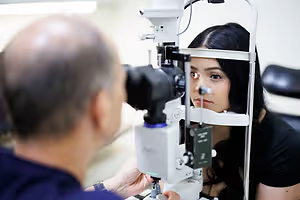
A comprehensive eye exam at our office is unhurried. We start with your history and any changes you have noticed since last year. Then we measure your vision and refine your prescription, check the pressure inside your eyes, and examine the front of the eye and the retina. Dilating drops widen your pupils so we can see the back of your eye clearly, which means bringing sunglasses and planning for a little blurry near vision for a few hours.
At the end, we walk you through what we found and what it means. You leave knowing your numbers, not just your prescription.
How Often Do You Need One?
For most healthy adults, the American Optometric Association recommends a comprehensive exam every one to two years. Yearly makes sense if you wear contact lenses, manage diabetes, have a family history of glaucoma or macular degeneration, or take a medication with known eye effects. Children should be checked before first grade and again whenever a parent or teacher notices a concern.
How Do You Book an Eye Exam Near Stone Ridge?
If night driving has started to feel like work, or if it has simply been more than a year, book before the holiday calendar fills up. Shorter days are here through March, and so is the glare.
Book your eye exam online or call our Aldie office at (703) 940-0988. We are at 24560 Southpoint Dr, minutes from Stone Ridge, South Riding, and Brambleton. You can also meet Dr. Sun before your first visit.